When Should a Startup Hire a Dedicated Development Team?
Cloudesk Editorial · October 11, 2026
Startups hire too early and too late. Too early creates payroll burn before learning. Too late creates founder exhaustion and missed windows. A dedicated development team — especially via subscription seats — is often the right middle move.
Hire a team when the calendar is full of product work you already believe in — not when you hope a developer will invent the company for you.
If founders are the bottleneck on execution and the roadmap is real, you are late — not early — for dedicated capacity.
If you landed here while comparing options around startup hire development team, skip the theory spiral. The useful question is simpler: what operating system will get work shipped in the next two to four weeks without burning your calendar on babysitting?
Signals you are ready

You have users or clear design partners. You can describe a 30-day outcome. Work will exist next week and the week after. Founders are the bottleneck on product execution.
Signals you should wait
You are still choosing a problem. You cannot prioritize. You want “someone technical” to invent the company. No seat and no employee can replace that founder job.
MVP vs dedicated team
A tiny prototype can be a founder + freelancer. The moment you are iterating on a live product with bugs, UX debt, and backlog, dedicated capacity with a PM pays for itself in avoided thrash.
Multi-skill reality
Modern products rarely need only one craft. Design + software, or website + automation, show up together. Subscription teams let you add seats without inventing a whole org chart.
A sane startup sequence
Validate problem → thin MVP slice → subscription seat for iteration → add seats for parallel work → hire in-house leads when revenue and complexity justify culture investment.
Startup stages vs hiring mode
| Stage | Typical need | Fit |
|---|---|---|
| Idea | Learning | Founder time |
| MVP slice | Fast build | Weekly seat or focused freelance |
| Active product | Continuous shipping | Monthly subscription team |
| Scale | Ownership + overflow | In-house core + seats |
How to tell the advice is working
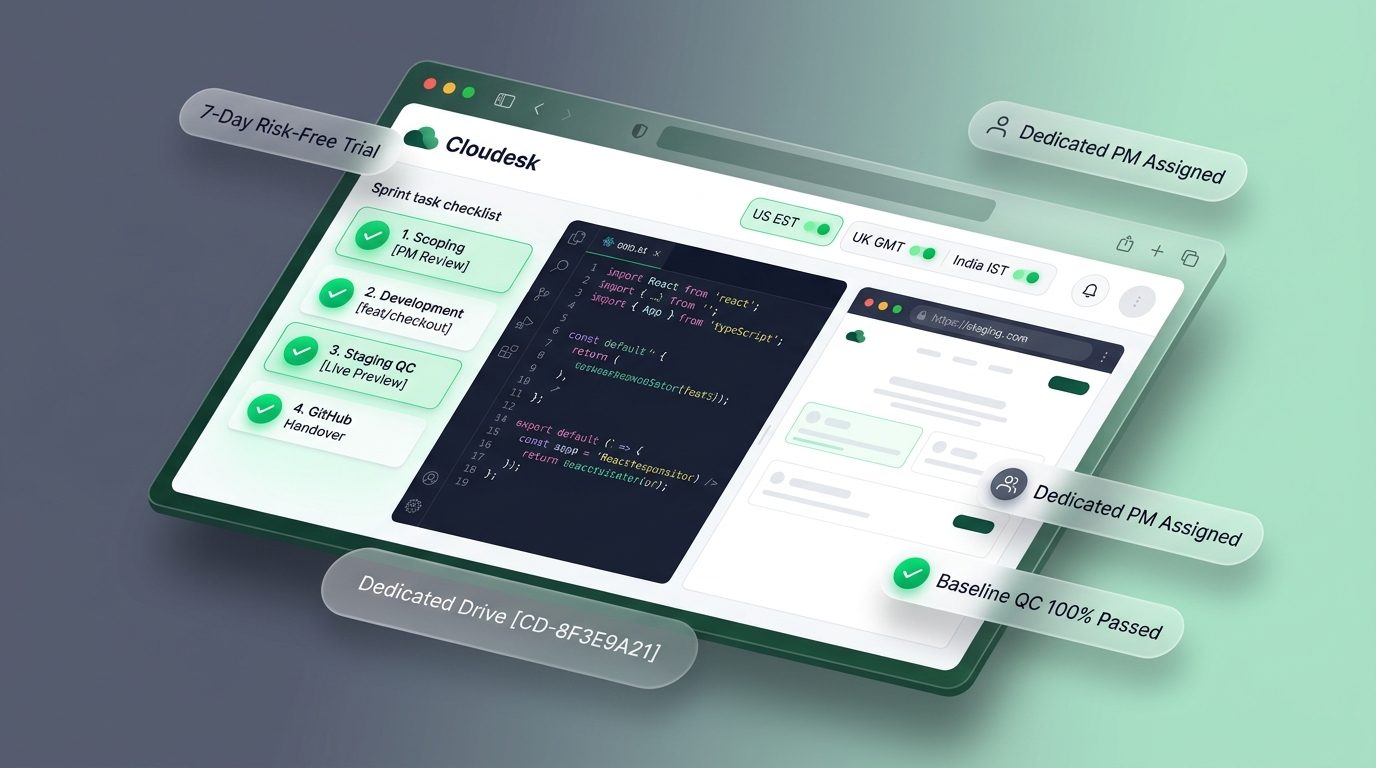
You will know your approach to startup hire development team is working when three things improve together: checklist items get accepted without drama, escaped bugs drop after QC, and you spend fewer hours chasing status. Invoice size alone is a lazy scorecard.
Mistakes that quietly burn money
1. Optimizing only for the cheapest day-rate
Cheap without continuity and QC becomes the most expensive path after rework.
2. No written definition of done
If acceptance criteria live in someone’s head, every delivery becomes a debate.
3. Buying capacity without backlog
Prepaid hours need ranked outcomes. Empty calendars waste money in every model.
4. Ignoring cancel/pause mechanics
Know how you leave before you enter. Healthy vendors are clear here.
Before you pay anyone
Run through this once — out loud if you have a co-founder:
- Is the work continuous for 30+ days?
- Do we need PM + checklist + QC included?
- Which role is the first seat?
- Weekly vs Monthly based on cadence?
- What does success look like in 14 days?
- Have we checked first-purchase 30% off and bundles?
Where Cloudesk fits
Cloudesk is a prepaid development team subscription: you pick specialist seats (Website, Software, App, AI / Automation, Graphic Design) and a Weekly (20h/40h) or Monthly (80h/160h) package.
New clients get 30% off the first purchase total. Autopay is optional. Cancel at period end from Billing. Skills on a role are configuration at +$0, not nickel-and-dime add-ons.
For startup hire development team, configure the smallest honest seat on /pricing, run two checklist cycles, and only then scale seats. The model proves itself in shipped work.
Related seat: Software Developer · configure on Pricing.
FAQ
Does this change how I should think about startup hire development team?
Yes — treat startup hire development team as an operating-model choice, not only a rate card. Continuity, PM ownership, and QC usually dominate sticker price over 90 days.
How does Cloudesk price this?
Fixed Weekly/Monthly seat packages. Configure on /pricing. First purchase is 30% off the total for new clients; multi-seat bundles can add permanent savings.
Can I start with one seat?
Yes. Most teams should. Add seats when a parallel stream is blocked.
Is Autopay required?
No. Authorize it only if you want automatic renewals.
Where should I go next?
Compare models on /subscription-development-team, then configure seats on /pricing.
What if priorities change mid-cycle?
Tell your Project Manager and re-confirm the checklist. Prepaid hours are capacity — not a prison for a stale brief about startup hire development team.
Next step
If startup hire development team is your bottleneck this month, see pricing and start with one clear checklist — first purchase is 30% off.
Need a AI & LLM Integration Developer?
Build production LLM pipelines, autonomous reasoning agents, vector RAG search, and custom ML workflows. Hire pre-vetted senior talent on flexible weekly or monthly subscriptions. Save up to 60% vs. in-house US payroll with zero recruiter fees and no long-term lock-in.
Explore Popular Engineering Roles