What Is a Subscription Development Team?
Cloudesk Editorial · October 11, 2026
A subscription development team is a hiring model where you buy ongoing development capacity on a Weekly or Monthly plan instead of posting jobs or collecting freelance bids. You are not purchasing a single deliverable. You are purchasing a standing lane of work: a Project Manager who owns scope, labelled specialists who build, and quality control that runs before you review.
I’ve watched founders say “we need developers” when what they actually need is a way to keep shipping after the first launch spike. A subscription team is that habit: same PM thread, same checklist discipline, fewer “who owns this?” mornings.
The label matters less than the mechanics: prepaid hours, a human who owns scope, specialists who show up in one thread, and QC before you review. If any of those pieces are missing, you do not have a subscription team — you have a renamed freelance roster.
Founders usually discover this model after two painful patterns. The first is the marketplace cycle — hire a freelancer, lose context, rehire, repeat. The second is the employment cycle — open a role, wait weeks, pay benefits, then watch idle weeks when the roadmap pauses. A subscription team sits between those extremes: prepaid hours, continuous chat, and an operating system that survives revisions.
Let’s talk about subscription development team the way operators talk about it: trade-offs, failure modes, and what “good” looks like when money and time are both limited.
What you actually buy

In a serious subscription model, the unit of purchase is a seat + package, not a vague retainer. On Cloudesk that means a role (Website, Software, App, AI / Automation, Graphic Design) plus a fixed hours package (Weekly 20h/40h or Monthly 80h/160h). Skills on a role are configuration, not upsells.
The commercial promise is predictability. You know the cycle price before work starts. You know who owns communication (the Project Manager). You know that Baseline QC is included. That is very different from “we will estimate after a discovery workshop” with open-ended burn.
- Prepaid Weekly or Monthly capacity
- One active project per seat, unlimited role-matched tasks under that seat
- Checklist confirmation before estimates
- Mandatory Baseline QC on every delivery
Subscription team vs freelancer vs agency vs in-house
Freelancers optimize for a single ticket. Agencies optimize for programs and account management. In-house optimizes for long-term ownership inside your payroll. A subscription development team optimizes for continuous shipping with less employment overhead.
If your roadmap has work every week — site improvements, product increments, automations, design systems — continuity compounds. Context lives in one PM thread. Checklists survive revision rounds. Adding a second seat creates a parallel stream instead of another chaotic Slack DM.
Who should use a subscription development team
This model fits startups past the napkin stage, agencies that need white-label delivery capacity, and SMBs that cannot justify a full engineering payroll yet. It is weaker when you need a single one-off brochure page with no follow-on work — a short freelance engagement can still win there.
It is also a strong bridge while you decide whether to hire full-time. Many teams run subscription seats for 90 days, learn the real workload, then keep seats, convert some work in-house, or mix both.
How work moves day to day
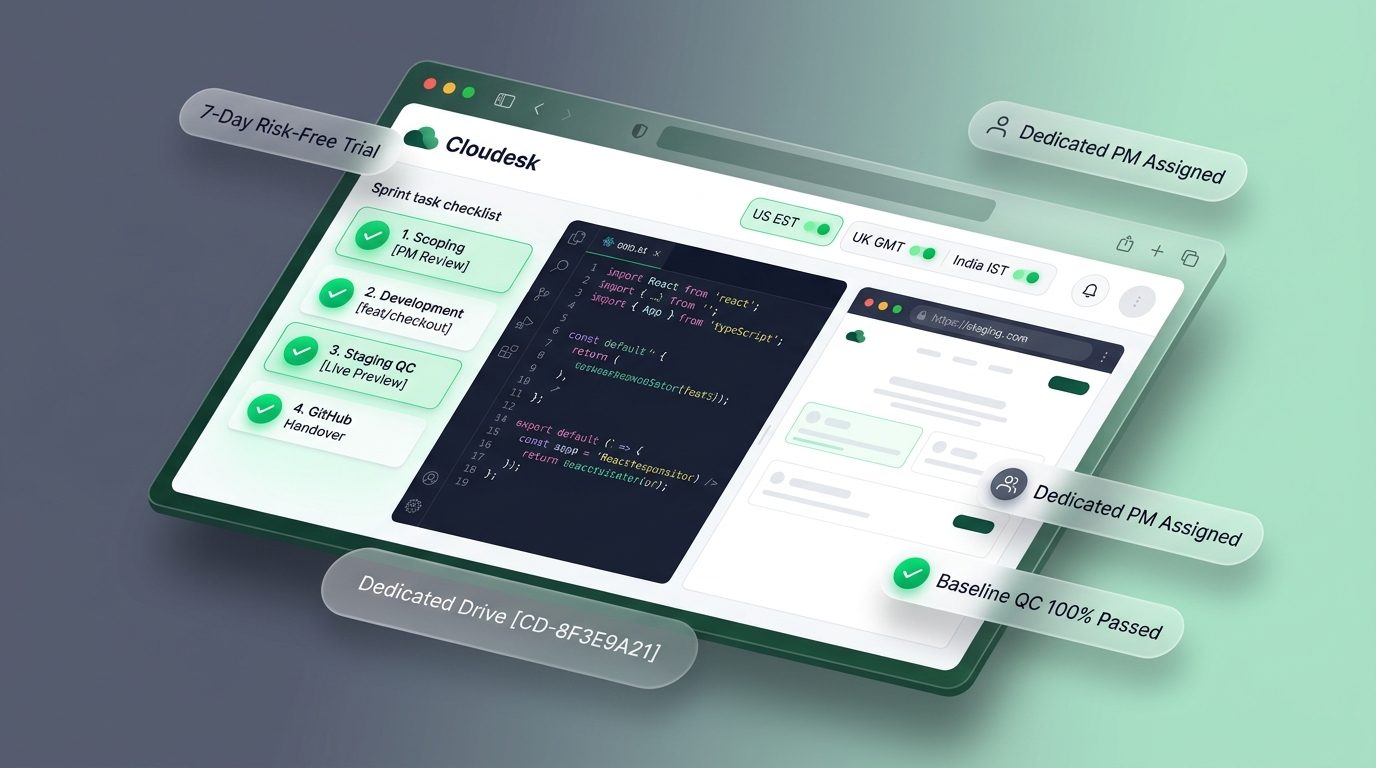
You describe outcomes in chat. The Project Manager turns them into a written checklist. You confirm. Hours are estimated against your prepaid package. Specialists build. Baseline QC checks the delivery. You review and request changes through the same PM thread.
That loop is the product. Without checklist discipline, “subscription” is just a marketing word for hourly chaos. With it, you can compare vendors on operating system quality — not only on sticker price.
Pricing shape and first-purchase economics
Price is driven by seats × package, plus permanent bundle savings when you run two or more seats. On Cloudesk, new clients also get 30% off the first purchase total, which is designed to make building a small team less scary than hiring one expensive generalist and hoping.
Always compare total cost of delivery: management time, rework, idle salary, and tool sprawl — not only the invoice line.
Model comparison at a glance
Use this when someone asks whether you should “just hire a freelancer.”
| Model | Best for | Main risk | Continuity |
|---|---|---|---|
| Freelancer | One-off tickets | Context loss / quality variance | Low |
| Agency retainer | Large multi-brand programs | Opaque hours / heavy process | Medium–High |
| In-house hire | Permanent product ownership | Recruiting delay + fixed cost | High |
| Subscription team | Ongoing shipping with PM + QC | Needs clear priorities from you | High |
How to tell the advice is working
You will know your approach to subscription development team is working when three things improve together: checklist items get accepted without drama, escaped bugs drop after QC, and you spend fewer hours chasing status. Invoice size alone is a lazy scorecard.
Mistakes that quietly burn money
1. Buying hours without a priority queue
Prepaid capacity without a ranked backlog turns into busywork. Bring outcomes, not a random task dump.
2. Treating the PM like a ticket bot
If you bypass scope confirmation, you recreate freelance chaos inside a subscription invoice.
3. Skipping QC to “move faster”
Fake speed creates revision loops. Baseline QC is cheaper than production incidents.
4. Hiring five seats before one stream works
Start with one clear project stream. Add seats when you are blocked on parallel work — not for vanity headcount.
Before you pay anyone
Run through this once — out loud if you have a co-founder:
- Is work continuous for the next 30–90 days?
- Do you need a written checklist owner (PM), or will you manage freelancers yourself?
- Is Baseline QC included, or is quality an upsell?
- Are packages fixed before payment?
- Can you cancel/pause without drama?
- Will multi-seat bundles matter as you grow?
Where Cloudesk fits
On Cloudesk you are not buying a mystery retainer. You buy a seat with clear hours, a dedicated Project Manager, and Baseline QC on every delivery.
New clients get 30% off the first purchase total. Autopay is optional. Cancel at period end from Billing. Skills on a role are configuration at +$0, not nickel-and-dime add-ons.
If you are still defining the model, start with one Monthly 80h seat on your primary skill (often Software or Website), ship for two weeks with checklist discipline, then decide whether to add Design, App, or AI seats.
Compare models on subscription development team, then configure on Pricing.
FAQ
Is a subscription development team the same as staff augmentation?
Not exactly. Staff aug often drops contractors into your Slack with you as the manager. Cloudesk includes a Project Manager, checklist scoping, and Baseline QC as the default operating system.
How many projects can one seat run?
One active project per seat. Unlimited role-matched tasks inside that project. Need concurrency? Add another seat.
Do I interview the specialists?
You work primarily with your PM. Specialists appear as labelled seats in chat. You review outcomes against the checklist.
Is Autopay required?
No. Autopay is optional when you authorize it at checkout.
What happens if I cancel?
You can cancel next cycle from Billing. Paid access continues through the current cycle per policy.
Where do I compare models in more detail?
Read the dedicated comparison page: /subscription-development-team, then configure seats on /pricing.
What if priorities change mid-cycle?
Tell your Project Manager and re-confirm the checklist. Prepaid hours are capacity — not a prison for a stale brief about subscription development team.
Next step
If subscription development team is your bottleneck this month, see pricing and start with one clear checklist — first purchase is 30% off.
Need a AI & LLM Integration Developer?
Build production LLM pipelines, autonomous reasoning agents, vector RAG search, and custom ML workflows. Hire pre-vetted senior talent on flexible weekly or monthly subscriptions. Save up to 60% vs. in-house US payroll with zero recruiter fees and no long-term lock-in.
Explore Popular Engineering Roles