Subscription Development vs Freelancers: What's the Difference?
Cloudesk Editorial · October 11, 2026
The internet loves a freelancer quote that undercuts everything. The bill you do not see is context loss: re-explaining the product, re-negotiating quality, and rediscovering edge cases every engagement. Subscription development and freelancing both buy labor. They do not buy the same operating system.
I like freelancers for sharp, finite jobs. I stop liking them when the product needs memory. The fifth revision of a checkout flow should not require re-explaining your brand voice from scratch.
Use freelancers when the work ends cleanly. Use a subscription seat when next month will look like this month. Mixing those instincts is how budgets get weird.
If you landed here while comparing options around subscription development vs freelancer, skip the theory spiral. The useful question is simpler: what operating system will get work shipped in the next two to four weeks without burning your calendar on babysitting?
Continuity and context

Freelancers are often engaged per deliverable. When the gig ends, memory leaves with them. A subscription seat keeps a Project Manager thread and checklist history so the fifth revision still knows what the first revision decided.
If your work is truly one landing page with no sequel, a freelancer can be rational. If you will ship weekly, continuity is the product.
Management load
With freelancers, you are the PM, stand-up, and QA lead unless you hire those roles separately. Subscription models put scope and routing on a Project Manager so founders review outcomes instead of babysitting task boards.
Quality variance
Marketplace talent ranges from excellent to chaotic. A subscription platform that mandates Baseline QC on every delivery reduces the left tail of quality — the silent bugs that show up after invoice.
Scaling behavior
Need parallel work? Hunting two more freelancers multiplies coordination. Adding a second Cloudesk seat creates another focused stream with the same PM system.
When freelancers still win
Ultra-narrow one-offs, experimental spikes you may throw away, or specialist art that is purely portfolio-driven can still favor a freelancer. Do not force a Monthly seat onto a three-hour icon request.
Freelancer vs subscription development
| Dimension | Freelancer | Subscription team |
|---|---|---|
| Engagement unit | Deliverable / hours | Weekly/Monthly seat |
| Default PM | Often you | Included PM |
| QC | Variable | Baseline QC included |
| Best fit | One-off | Ongoing shipping |
How to tell the advice is working
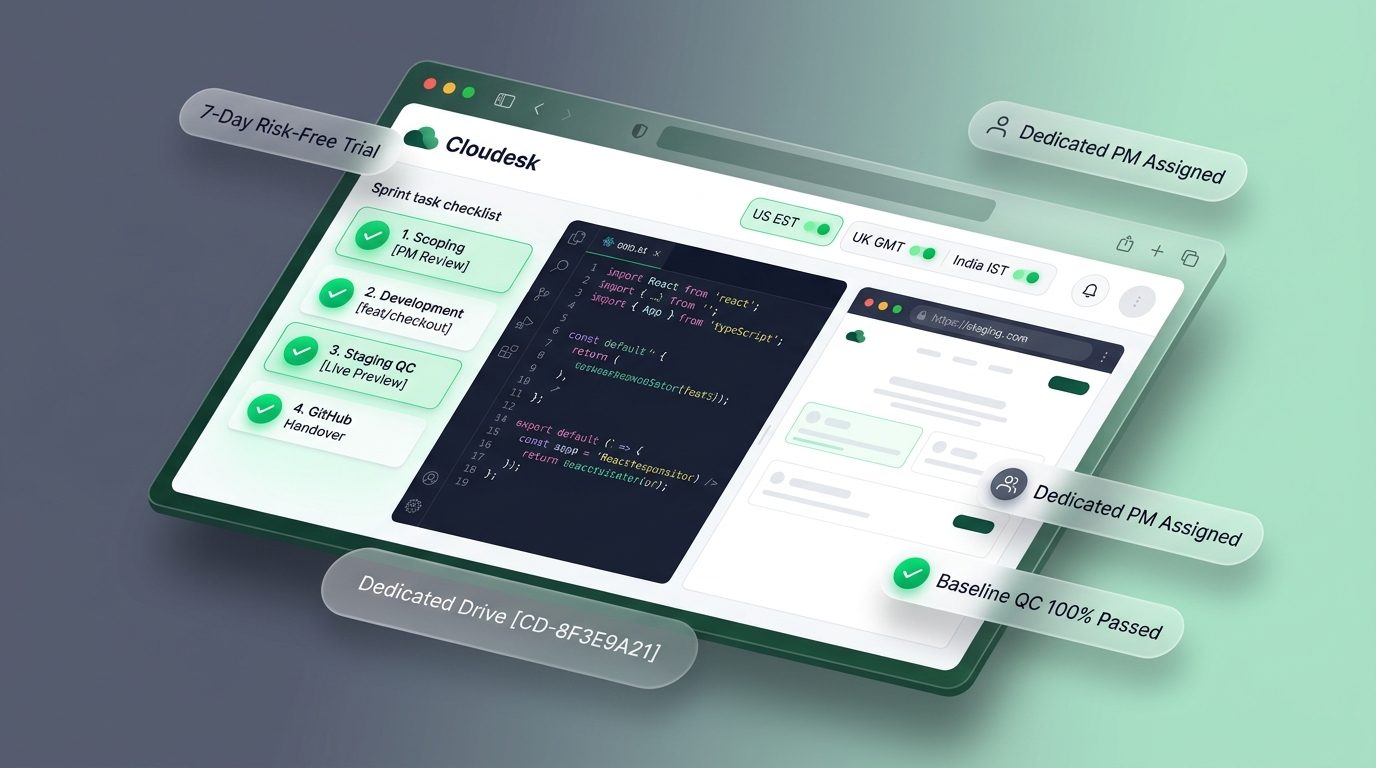
You will know your approach to subscription development vs freelancer is working when three things improve together: checklist items get accepted without drama, escaped bugs drop after QC, and you spend fewer hours chasing status. Invoice size alone is a lazy scorecard.
Mistakes that quietly burn money
1. Optimizing only for the cheapest day-rate
Cheap without continuity and QC becomes the most expensive path after rework.
2. No written definition of done
If acceptance criteria live in someone’s head, every delivery becomes a debate.
3. Buying capacity without backlog
Prepaid hours need ranked outcomes. Empty calendars waste money in every model.
4. Ignoring cancel/pause mechanics
Know how you leave before you enter. Healthy vendors are clear here.
Before you pay anyone
Run through this once — out loud if you have a co-founder:
- Is the work continuous for 30+ days?
- Do we need PM + checklist + QC included?
- Which role is the first seat?
- Weekly vs Monthly based on cadence?
- What does success look like in 14 days?
- Have we checked first-purchase 30% off and bundles?
Where Cloudesk fits
On Cloudesk you are not buying a mystery retainer. You buy a seat with clear hours, a dedicated Project Manager, and Baseline QC on every delivery.
New clients get 30% off the first purchase total. Autopay is optional. Cancel at period end from Billing. Skills on a role are configuration at +$0, not nickel-and-dime add-ons.
For subscription development vs freelancer, configure the smallest honest seat on /pricing, run two checklist cycles, and only then scale seats. The model proves itself in shipped work.
Compare models on subscription development team, then configure on Pricing.
FAQ
Does this change how I should think about subscription development vs freelancer?
Yes — treat subscription development vs freelancer as an operating-model choice, not only a rate card. Continuity, PM ownership, and QC usually dominate sticker price over 90 days.
How does Cloudesk price this?
Fixed Weekly/Monthly seat packages. Configure on /pricing. First purchase is 30% off the total for new clients; multi-seat bundles can add permanent savings.
Can I start with one seat?
Yes. Most teams should. Add seats when a parallel stream is blocked.
Is Autopay required?
No. Authorize it only if you want automatic renewals.
Where should I go next?
Compare models on /subscription-development-team, then configure seats on /pricing.
What if priorities change mid-cycle?
Tell your Project Manager and re-confirm the checklist. Prepaid hours are capacity — not a prison for a stale brief about subscription development vs freelancer.
Next step
If subscription development vs freelancer is your bottleneck this month, see pricing and start with one clear checklist — first purchase is 30% off.
Need a AI & LLM Integration Developer?
Build production LLM pipelines, autonomous reasoning agents, vector RAG search, and custom ML workflows. Hire pre-vetted senior talent on flexible weekly or monthly subscriptions. Save up to 60% vs. in-house US payroll with zero recruiter fees and no long-term lock-in.
Explore Popular Engineering Roles