How to Hire Developers for a Startup
Cloudesk Editorial · October 11, 2026
Startup hiring is sequencing under uncertainty. Hire for the next milestone, not for an org chart you saw on Twitter.
Hire for the next milestone under uncertainty. Org charts copied from bigger companies are how runway dies quietly.
Milestone first. Multi-seat only when crafts must move in parallel. Runway is a feature.
Most teams researching hire developers for startup already know the pain — missed weeks, fuzzy scope, or a hire that takes forever. What they need is a clear way to choose a model and start.
Milestone-based hiring
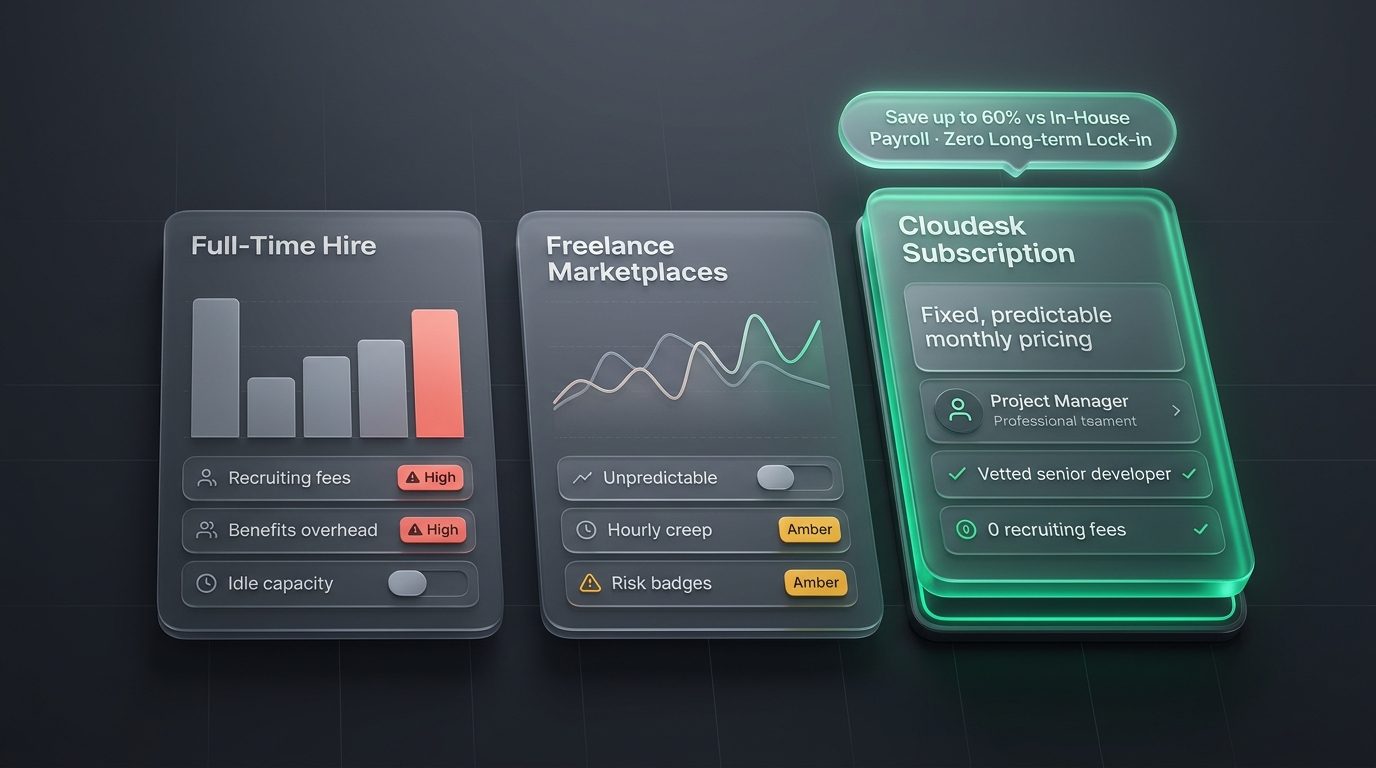
MVP slice, launch, or growth hardening each needs different seat mixes.
Avoid premature headcount
Subscription seats validate workload before employment fixed costs.
Multi-role early is normal
Product + design often move together. Bundles help.
Protect runway
Fixed packages + 30% first purchase intro beat surprise agency change orders for many early teams.
Graduate deliberately
When IP and culture need daily internal ownership, hire leads — keep seats for overflow.
Startup hiring sequence
| Stage | Move |
|---|---|
| Unclear problem | Do not hire |
| Slice ready | One Software seat |
| UX blocked | Add Design |
| Parallel surfaces | Add App/AI seats |
How to tell the advice is working

You will know your approach to hire developers for startup is working when three things improve together: checklist items get accepted without drama, escaped bugs drop after QC, and you spend fewer hours chasing status. Invoice size alone is a lazy scorecard.
Mistakes that quietly burn money
1. Choosing vendors only on day-rate
Ignore PM, QC, and continuity and you will pay in rework.
2. No written acceptance criteria
Every delivery becomes a negotiation.
3. Managing five channels
Scatter creates silent scope drift. Prefer one PM thread.
4. Hiring a team before a milestone exists
Capacity without a job becomes expensive motion.
Before you pay anyone
Run through this once — out loud if you have a co-founder:
- What outcome matters in 30 days?
- Freelancer, agency, subscription, or in-house?
- Which first seat/role?
- How will we review quality weekly?
- What are cancel/pause rules?
Where Cloudesk fits
If you want the middle path between freelancers and a heavy agency, Cloudesk is built as subscription seats with chat-first PM delivery.
New clients get 30% off the first purchase total. Autopay is optional. Cancel at period end from Billing. Skills on a role are configuration at +$0, not nickel-and-dime add-ons.
For hire developers for startup, configure the smallest honest team on /pricing, run two checklist cycles with your PM, and scale seats only when throughput — not ego — demands it.
Compare models on subscription development team, then configure on Pricing.
FAQ
How does Cloudesk help with hire developers for startup?
Cloudesk provides prepaid specialist seats with a dedicated Project Manager, checklist scoping, and mandatory Baseline QC — a practical middle path between freelancers and heavy agencies.
Can I start with one developer seat?
Yes. Add seats when parallel work is blocked. Bundles help at 2+ seats.
Is Autopay required?
No.
First purchase offer?
30% off the first cycle total for new clients.
Where do I compare models?
/subscription-development-team and /pricing.
Is this only for big companies?
No. Most teams looking at hire developers for startup are startups and SMBs that need shipping capacity without a full eng org. Start with one seat.
Next step
Ready to stop re-hiring for the same work? Build your seat on Pricing. First purchase is 30% off the total.
Need a AI & LLM Integration Developer?
Build production LLM pipelines, autonomous reasoning agents, vector RAG search, and custom ML workflows. Hire pre-vetted senior talent on flexible weekly or monthly subscriptions. Save up to 60% vs. in-house US payroll with zero recruiter fees and no long-term lock-in.
Explore Popular Engineering Roles