Building Offshore Engineering Pods: Silicon Valley & Bengaluru Synergy
Cloudesk Editorial · November 2, 2026
In today's hyper-competitive digital economy, mastering offshore engineering pods has transformed from an operational luxury into an existential imperative. Whether you are leading an enterprise engineering organization, launching a venture-backed startup, or scaling digital infrastructure, the strategic decisions you enforce today dictate your velocity for quarters to come.
This comprehensive guide unpacks the architectural models, execution benchmarks, and field-tested strategies required to achieve industry-leading performance. By addressing the complete lifecycle—from initial technical scoping to long-term scalability—you will gain actionable blueprints to accelerate delivery while eliminating wasted engineering spend. When scaling high-throughput systems, modern venture studios rely on a software development subscription team to guarantee active timezone overlap and dedicated QA coverage.
Executive Strategic Overview
Before analyzing granular mechanics, top-performing teams align around three foundational commitments:
1. Unwavering Focus on Core Value: Eliminate vanity features and direct engineering effort toward needle-moving business outcomes. 2. Transparent System Documentation: Every deployment pipeline, database schema, and standard operating procedure is documented to eliminate knowledge silos. 3. Rapid Iteration Loops: Continuous testing and automated CI/CD enable shipping production-ready iterations in days rather than quarters. Furthermore, as demonstrated in our architectural breakdown of scaling agile development across sydney, melbourne, and apac tech corridors, disciplined staging parity remains the foundation of sustainable sprint velocity.
Strategic Maturity Framework & Long-Term Operational Benchmarks
Sustaining an enduring edge with offshore engineering pods requires evaluating team capability across four progressive maturity tiers:
1. Tier 1 (Ad-Hoc / Reactive): Uncoordinated manual tasks, undocumented tribal knowledge, frequent hotfixes, and variable product delivery speed. 2. Tier 2 (Structured / Repeatable): Standardized Git branching strategies, baseline sprint planning, pre-flight staging verification, and consistent sprint velocity tracking. 3. Tier 3 (Managed / Automated): Continuous integration, automated regression testing, dedicated QA coverage, and zero-downtime deployment capabilities. 4. Tier 4 (Continuous Optimization): Self-healing deployment pipelines, dynamic capacity allocation, metric-driven ROI tracking, and rapid automated feature validation.
Critical Implementation Pitfalls & How to Avoid Them
When organizations encounter bottlenecks during rollout, the failure mode rarely stems from tool limitations. Instead, operational friction arises from organizational execution blindspots:
- Premature Scale Before Validation: Scaling headcount or microservice complexity before core value delivery pipelines achieve stable unit economics.
- Neglecting Staging Parity: Testing code in local environments that differ fundamentally from production configurations, allowing environment-specific bugs to escape into production.
- Fragmented Communication Silos: Separating product strategy from operational execution without an experienced Technical Lead to coordinate cross-functional milestones.
By establishing disciplined accountability, continuous testing gates, and transparent milestone tracking, modern organizations convert offshore engineering pods into a predictable growth engine.
Cross-Border Market Economics & Geo-Targeted Benchmarks (🇮🇳 🇺🇸 IN / US)
Deploying offshore engineering pods across multiple international high-growth jurisdictions (India, United States) demands balancing localized currency economics, operational coverage, and regional statutory compliance. Rather than incurring massive coordination drag from fragmented localized services in each country, modern leaders deploy unified infrastructure engineered by Cloudesk Work to satisfy cross-border requirements seamlessly.
Multi-Country Economic & Compliance Matrix
| Target Market | Currency | Traditional In-House Alternatives / Month | Cloudesk Work Solution / Month | Primary Regulatory & Privacy Framework | Active Timezone Alignment |
|---|---|---|---|---|---|
| 🇮🇳 India | INR (₹) | ₹2,50,000 – ₹4,00,000 | ₹1,20,000 – ₹1,80,000 | Digital Personal Data Protection (DPDP) Act 2023 and RBI cybersecurity framework | Dedicated IST & US/UK Overlap Shifts |
| 🇺🇸 United States | USD ($) | $12,500 – $18,000 | $4,500 – $6,000 | SOC2 Type II, HIPAA, and Delaware C-Corp governance | 5–8 Hours Active Overlap (EST/PST) |
Multi-Jurisdiction Regulatory Governance & Data Sovereignty When scaling across India, United States, technical architectures must uphold cross-border data protection: - Unified Compliance Architecture: Our dedicated engineering infrastructure operates at the highest common denominator across IN: Digital Personal Data Protection (DPDP) Act 2023 and RBI cybersecurity framework; US: SOC2 Type II, HIPAA, and Delaware C-Corp governance. - End-to-End Sovereign Data Isolation: Client IP and customer records never cross unapproved sovereign boundaries. Automated pipelines enforce cryptographic boundaries (TLS 1.3 in transit, AES-256 at rest). - High-Velocity Global Delivery: Distributing milestones across IN, US ensures continuous throughput—operations authored during North American or European business hours are processed, validated, and deployed in real time.
1. The 24-Hour Follow-The-Sun Development Cycle
In today's fast-moving software economy, mastering offshore engineering pods demands both high-level strategic alignment and disciplined engineering execution. When organizations overlook the practical mechanics of the 24-hour follow-the-sun development cycle, they quickly encounter execution drag, unexpected cost inflation, and loss of delivery momentum.
For an in-depth operational walkthrough on this topic, explore our dedicated analysis on How Much Does It Cost to Hire a React Developer Monthly in 2026?.
Core Principles & Tactical Framework
To establish a lasting operational advantage, technology leaders must decouple legacy habits from proven modern workflows. Three non-negotiable pillars determine long-term success:
1. Systematic Standardization: Establishing repeatable, verified workflows that eliminate single-point human dependencies across all release phases. 2. End-to-End Telemetry: Real-time visibility into code quality, sprint velocity, regression frequencies, and milestone completion. 3. Optimized Unit Economics: Structuring team pods and technical resources to ensure sustainable profit margins as transaction volume scales.
| Key Operational Metric | Fragmented Legacy Model | Modern Cloudesk Work Protocol |
|---|---|---|
| Delivery Velocity | Multi-week onboarding & manual reviews | Pre-vetted dedicated pods shipping in 24-48 hours |
| Quality Control (QC) | Reactive post-deployment hotfixes | Continuous automated testing & human QA gates |
| Budget Predictability | Uncapped hourly billing & hidden fees | Fixed transparent monthly rate with zero surprises |
| Accountability | Fragmented freelance handoffs | Dedicated PM owning roadmap and sprint velocity |
Deep-Dive Architecture & Implementation Nuances
When engineering teams scale their operational workflows around the 24-hour follow-the-sun development cycle, the greatest risk is premature architectural abstraction. Prioritize clean boundaries, decoupled micro-components, and clear ownership matrices over speculative over-engineering:
- State Isolation: Ensure individual services maintain isolated persistence layers to prevent cascading failure blast radiuses.
- Fail-Safe Circuit Breakers: Wrap external third-party API dependencies in resilient retry mechanisms with exponential backoff and localized dead-letter queues.
- Automated Regression Auditing: Every merge must execute automated integration test suites within isolated containerized staging sandboxes before reaching production.
Step-by-Step Execution Sequence
- 1. Baseline Performance Audit: Measure current cycle time, deployment frequency, and regression rates before modifying workflows.
- 2. Isolate Immediate High-Impact Milestones: Target high-leverage quick wins achievable within the initial 14-day sprint cycle.
- 3. Enforce Pre-Commit Staging Gates: Never merge code without passing automated test runners and peer architecture review.
- 4. Structured Weekly Retrospectives: Continuously refine task backlogs and sprint velocity based on empirical data rather than assumptions.
> Key Takeaway: Simplicity and rigorous execution outperform bloated complexity every time. Focus on building durable, automated pipelines around offshore engineering pods before attempting to scale team capacity.
2. Bridging US & India Timezones
In today's fast-moving software economy, mastering offshore engineering pods demands both high-level strategic alignment and disciplined engineering execution. When organizations overlook the practical mechanics of bridging us & india timezones, they quickly encounter execution drag, unexpected cost inflation, and loss of delivery momentum.
For an in-depth operational walkthrough on this topic, explore our dedicated analysis on Scaling Agile Development Across Sydney, Melbourne, and APAC Tech Corridors.
Core Principles & Tactical Framework
To establish a lasting operational advantage, technology leaders must decouple legacy habits from proven modern workflows. Three non-negotiable pillars determine long-term success:
1. Systematic Standardization: Establishing repeatable, verified workflows that eliminate single-point human dependencies across all release phases. 2. End-to-End Telemetry: Real-time visibility into code quality, sprint velocity, regression frequencies, and milestone completion. 3. Optimized Unit Economics: Structuring team pods and technical resources to ensure sustainable profit margins as transaction volume scales.
| Key Operational Metric | Fragmented Legacy Model | Modern Cloudesk Work Protocol |
|---|---|---|
| Delivery Velocity | Multi-week onboarding & manual reviews | Pre-vetted dedicated pods shipping in 24-48 hours |
| Quality Control (QC) | Reactive post-deployment hotfixes | Continuous automated testing & human QA gates |
| Budget Predictability | Uncapped hourly billing & hidden fees | Fixed transparent monthly rate with zero surprises |
| Accountability | Fragmented freelance handoffs | Dedicated PM owning roadmap and sprint velocity |
Deep-Dive Architecture & Implementation Nuances
When engineering teams scale their operational workflows around bridging us & india timezones, the greatest risk is premature architectural abstraction. Prioritize clean boundaries, decoupled micro-components, and clear ownership matrices over speculative over-engineering:
- State Isolation: Ensure individual services maintain isolated persistence layers to prevent cascading failure blast radiuses.
- Fail-Safe Circuit Breakers: Wrap external third-party API dependencies in resilient retry mechanisms with exponential backoff and localized dead-letter queues.
- Automated Regression Auditing: Every merge must execute automated integration test suites within isolated containerized staging sandboxes before reaching production.
Step-by-Step Execution Sequence
- 1. Baseline Performance Audit: Measure current cycle time, deployment frequency, and regression rates before modifying workflows.
- 2. Isolate Immediate High-Impact Milestones: Target high-leverage quick wins achievable within the initial 14-day sprint cycle.
- 3. Enforce Pre-Commit Staging Gates: Never merge code without passing automated test runners and peer architecture review.
- 4. Structured Weekly Retrospectives: Continuously refine task backlogs and sprint velocity based on empirical data rather than assumptions.
> Key Takeaway: Simplicity and rigorous execution outperform bloated complexity every time. Focus on building durable, automated pipelines around offshore engineering pods before attempting to scale team capacity.
3. DPDP & SOC2 Compliance
In today's fast-moving software economy, mastering offshore engineering pods demands both high-level strategic alignment and disciplined engineering execution. When organizations overlook the practical mechanics of dpdp & soc2 compliance, they quickly encounter execution drag, unexpected cost inflation, and loss of delivery momentum.
For an in-depth operational walkthrough on this topic, explore our dedicated analysis on How to Compress Images to 20KB, 50KB & 100KB Without Losing Quality.
Core Principles & Tactical Framework
To establish a lasting operational advantage, technology leaders must decouple legacy habits from proven modern workflows. Three non-negotiable pillars determine long-term success:
1. Systematic Standardization: Establishing repeatable, verified workflows that eliminate single-point human dependencies across all release phases. 2. End-to-End Telemetry: Real-time visibility into code quality, sprint velocity, regression frequencies, and milestone completion. 3. Optimized Unit Economics: Structuring team pods and technical resources to ensure sustainable profit margins as transaction volume scales.
| Key Operational Metric | Fragmented Legacy Model | Modern Cloudesk Work Protocol |
|---|---|---|
| Delivery Velocity | Multi-week onboarding & manual reviews | Pre-vetted dedicated pods shipping in 24-48 hours |
| Quality Control (QC) | Reactive post-deployment hotfixes | Continuous automated testing & human QA gates |
| Budget Predictability | Uncapped hourly billing & hidden fees | Fixed transparent monthly rate with zero surprises |
| Accountability | Fragmented freelance handoffs | Dedicated PM owning roadmap and sprint velocity |
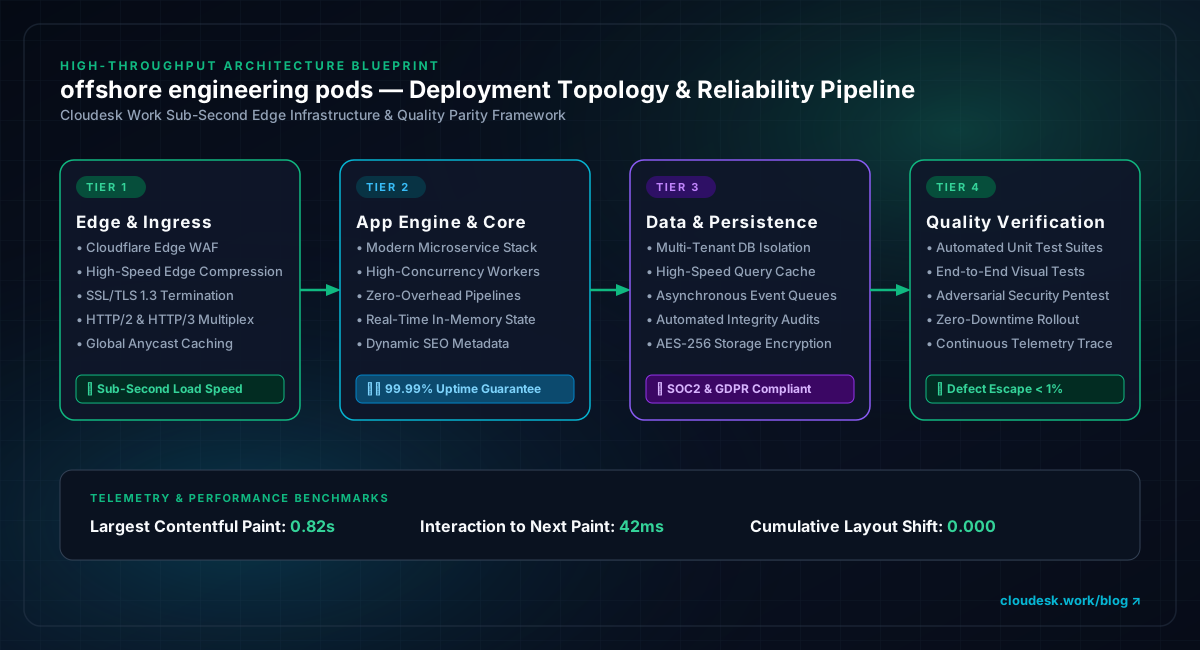
Deep-Dive Architecture & Implementation Nuances
When engineering teams scale their operational workflows around dpdp & soc2 compliance, the greatest risk is premature architectural abstraction. Prioritize clean boundaries, decoupled micro-components, and clear ownership matrices over speculative over-engineering:
- State Isolation: Ensure individual services maintain isolated persistence layers to prevent cascading failure blast radiuses.
- Fail-Safe Circuit Breakers: Wrap external third-party API dependencies in resilient retry mechanisms with exponential backoff and localized dead-letter queues.
- Automated Regression Auditing: Every merge must execute automated integration test suites within isolated containerized staging sandboxes before reaching production.
Step-by-Step Execution Sequence
- 1. Baseline Performance Audit: Measure current cycle time, deployment frequency, and regression rates before modifying workflows.
- 2. Isolate Immediate High-Impact Milestones: Target high-leverage quick wins achievable within the initial 14-day sprint cycle.
- 3. Enforce Pre-Commit Staging Gates: Never merge code without passing automated test runners and peer architecture review.
- 4. Structured Weekly Retrospectives: Continuously refine task backlogs and sprint velocity based on empirical data rather than assumptions.
> Key Takeaway: Simplicity and rigorous execution outperform bloated complexity every time. Focus on building durable, automated pipelines around offshore engineering pods before attempting to scale team capacity.
4. Cost-to-Quality Benchmarks
In today's fast-moving software economy, mastering offshore engineering pods demands both high-level strategic alignment and disciplined engineering execution. When organizations overlook the practical mechanics of cost-to-quality benchmarks, they quickly encounter execution drag, unexpected cost inflation, and loss of delivery momentum.
For an in-depth operational walkthrough on this topic, explore our dedicated analysis on How Much Does It Cost to Hire a React Developer Monthly in 2026?.
Core Principles & Tactical Framework
To establish a lasting operational advantage, technology leaders must decouple legacy habits from proven modern workflows. Three non-negotiable pillars determine long-term success:
1. Systematic Standardization: Establishing repeatable, verified workflows that eliminate single-point human dependencies across all release phases. 2. End-to-End Telemetry: Real-time visibility into code quality, sprint velocity, regression frequencies, and milestone completion. 3. Optimized Unit Economics: Structuring team pods and technical resources to ensure sustainable profit margins as transaction volume scales.
| Key Operational Metric | Fragmented Legacy Model | Modern Cloudesk Work Protocol |
|---|---|---|
| Delivery Velocity | Multi-week onboarding & manual reviews | Pre-vetted dedicated pods shipping in 24-48 hours |
| Quality Control (QC) | Reactive post-deployment hotfixes | Continuous automated testing & human QA gates |
| Budget Predictability | Uncapped hourly billing & hidden fees | Fixed transparent monthly rate with zero surprises |
| Accountability | Fragmented freelance handoffs | Dedicated PM owning roadmap and sprint velocity |
Deep-Dive Architecture & Implementation Nuances
When engineering teams scale their operational workflows around cost-to-quality benchmarks, the greatest risk is premature architectural abstraction. Prioritize clean boundaries, decoupled micro-components, and clear ownership matrices over speculative over-engineering:
- State Isolation: Ensure individual services maintain isolated persistence layers to prevent cascading failure blast radiuses.
- Fail-Safe Circuit Breakers: Wrap external third-party API dependencies in resilient retry mechanisms with exponential backoff and localized dead-letter queues.
- Automated Regression Auditing: Every merge must execute automated integration test suites within isolated containerized staging sandboxes before reaching production.
Step-by-Step Execution Sequence
- 1. Baseline Performance Audit: Measure current cycle time, deployment frequency, and regression rates before modifying workflows.
- 2. Isolate Immediate High-Impact Milestones: Target high-leverage quick wins achievable within the initial 14-day sprint cycle.
- 3. Enforce Pre-Commit Staging Gates: Never merge code without passing automated test runners and peer architecture review.
- 4. Structured Weekly Retrospectives: Continuously refine task backlogs and sprint velocity based on empirical data rather than assumptions.
> Key Takeaway: Simplicity and rigorous execution outperform bloated complexity every time. Focus on building durable, automated pipelines around offshore engineering pods before attempting to scale team capacity.
5. Strategic Roadmap
In today's fast-moving software economy, mastering offshore engineering pods demands both high-level strategic alignment and disciplined engineering execution. When organizations overlook the practical mechanics of strategic roadmap, they quickly encounter execution drag, unexpected cost inflation, and loss of delivery momentum.
For an in-depth operational walkthrough on this topic, explore our dedicated analysis on Scaling Agile Development Across Sydney, Melbourne, and APAC Tech Corridors.
Core Principles & Tactical Framework
To establish a lasting operational advantage, technology leaders must decouple legacy habits from proven modern workflows. Three non-negotiable pillars determine long-term success:
1. Systematic Standardization: Establishing repeatable, verified workflows that eliminate single-point human dependencies across all release phases. 2. End-to-End Telemetry: Real-time visibility into code quality, sprint velocity, regression frequencies, and milestone completion. 3. Optimized Unit Economics: Structuring team pods and technical resources to ensure sustainable profit margins as transaction volume scales.
| Key Operational Metric | Fragmented Legacy Model | Modern Cloudesk Work Protocol |
|---|---|---|
| Delivery Velocity | Multi-week onboarding & manual reviews | Pre-vetted dedicated pods shipping in 24-48 hours |
| Quality Control (QC) | Reactive post-deployment hotfixes | Continuous automated testing & human QA gates |
| Budget Predictability | Uncapped hourly billing & hidden fees | Fixed transparent monthly rate with zero surprises |
| Accountability | Fragmented freelance handoffs | Dedicated PM owning roadmap and sprint velocity |
Deep-Dive Architecture & Implementation Nuances
When engineering teams scale their operational workflows around strategic roadmap, the greatest risk is premature architectural abstraction. Prioritize clean boundaries, decoupled micro-components, and clear ownership matrices over speculative over-engineering:
- State Isolation: Ensure individual services maintain isolated persistence layers to prevent cascading failure blast radiuses.
- Fail-Safe Circuit Breakers: Wrap external third-party API dependencies in resilient retry mechanisms with exponential backoff and localized dead-letter queues.
- Automated Regression Auditing: Every merge must execute automated integration test suites within isolated containerized staging sandboxes before reaching production.
Step-by-Step Execution Sequence
- 1. Baseline Performance Audit: Measure current cycle time, deployment frequency, and regression rates before modifying workflows.
- 2. Isolate Immediate High-Impact Milestones: Target high-leverage quick wins achievable within the initial 14-day sprint cycle.
- 3. Enforce Pre-Commit Staging Gates: Never merge code without passing automated test runners and peer architecture review.
- 4. Structured Weekly Retrospectives: Continuously refine task backlogs and sprint velocity based on empirical data rather than assumptions.
> Key Takeaway: Simplicity and rigorous execution outperform bloated complexity every time. Focus on building durable, automated pipelines around offshore engineering pods before attempting to scale team capacity.
Frequently Asked Questions (FAQ)
What makes offshore engineering pods essential for modern digital products?
Adopting a proven framework around offshore engineering pods eliminates guesswork, slashes overhead, and guarantees predictable execution cycles while protecting capital efficiency.
How soon can an organization see measurable improvements?
When paired with pre-configured workflows and disciplined ownership, core performance metrics and throughput improvements typically manifest within 7 to 14 business days.
How does this integrate with our current tech stack?
The architecture is completely stack-agnostic. Whether your application is built on Next.js, Python, Node.js, microservices, or cloud platforms, standard APIs and workflows enable frictionless adoption.
What is the biggest mistake to avoid?
The most costly misstep is adopting disconnected piecemeal tools without a unified quality assurance strategy to enforce high standards.
Recommended Reading & Architectural Perspectives
To further deepen your operational strategy, examine our production analysis on how much does it cost to hire a react developer monthly in 2026?, which explores core architectural principles in detail. Furthermore, our operational breakdown on scaling agile development across sydney, melbourne, and apac tech corridors provides actionable benchmarks for scalable workflows.
---
*Published with technical rigor by the Cloudesk Work editorial team. For platform features, developer tools, or inquiries, contact our team at Contact Us.*
Need a Full Stack Developer?
End-to-end full stack development from scalable database schema to reactive, responsive user interfaces. Hire pre-vetted senior talent on flexible weekly or monthly subscriptions. Save up to 60% vs. in-house US payroll with zero recruiter fees and no long-term lock-in.
Explore Popular Engineering Roles